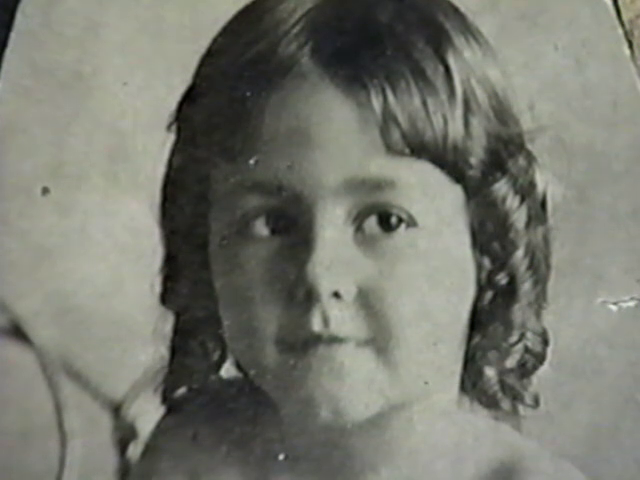
Happy heavenly birthday to Helen Morgan, who was born 123 years ago today!
Yes, on August 2, 1902, not 1900. For more on this, see last year’s birthday post.
August 2, 1902 was not a happy natal day.
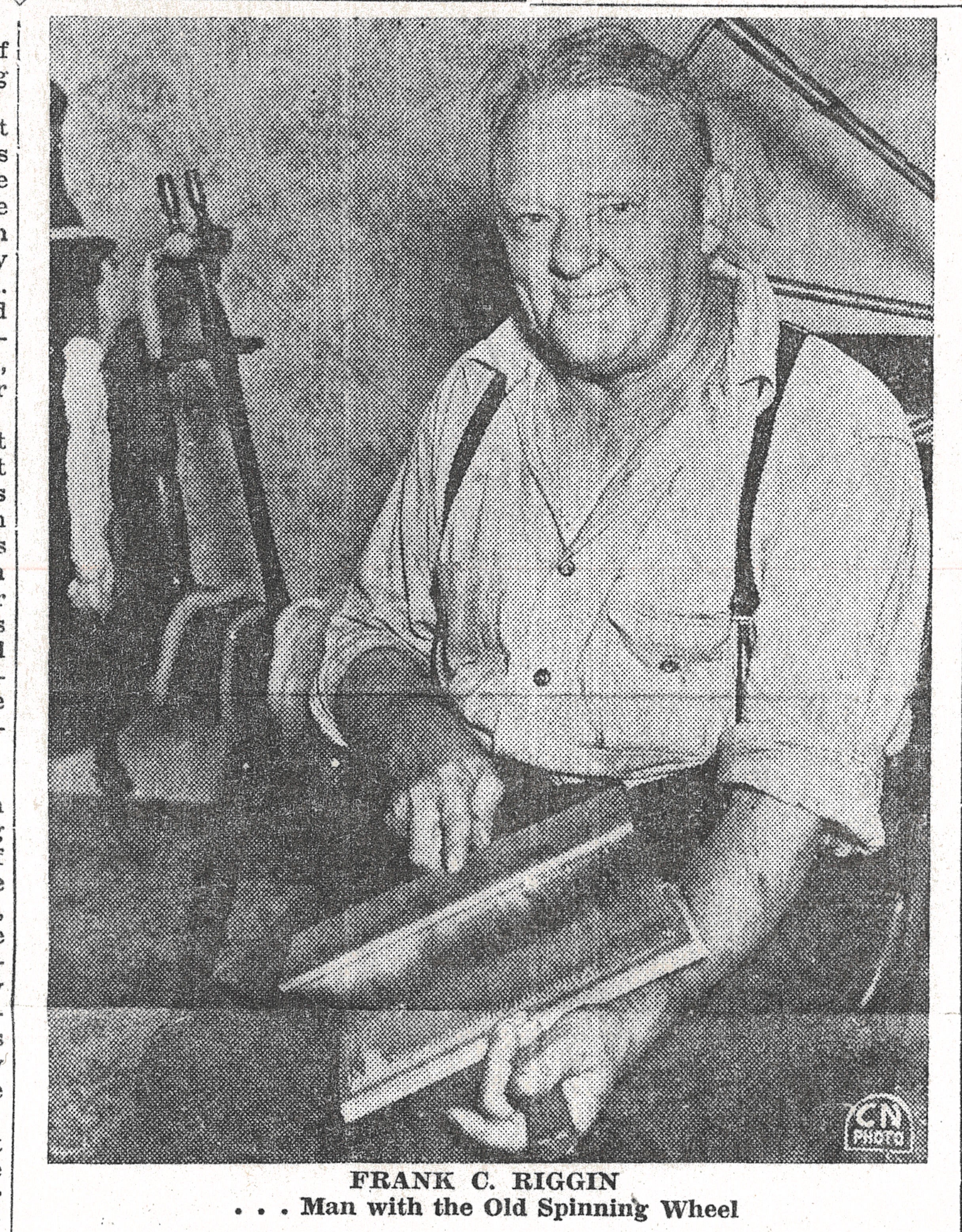
Her parents, Lulu Lang and Frank Riggin, married on September 3, 1899, under an unlucky star. Lulu Lang came from hardy farmer stock, but Frank took ill while serving in the Spanish-American War. Not during any battle, but while at boot camp. He was discharged long before his unit went to the front lines. He battled multiple medical issues throughout the remainder of his life.
Disaster struck on June 21, 1901, when Lulu gave birth, prematurely, to a stillborn son.
Ten months later, while Lulu was pregnant a second time, the couple separated, on April 14, 1902.
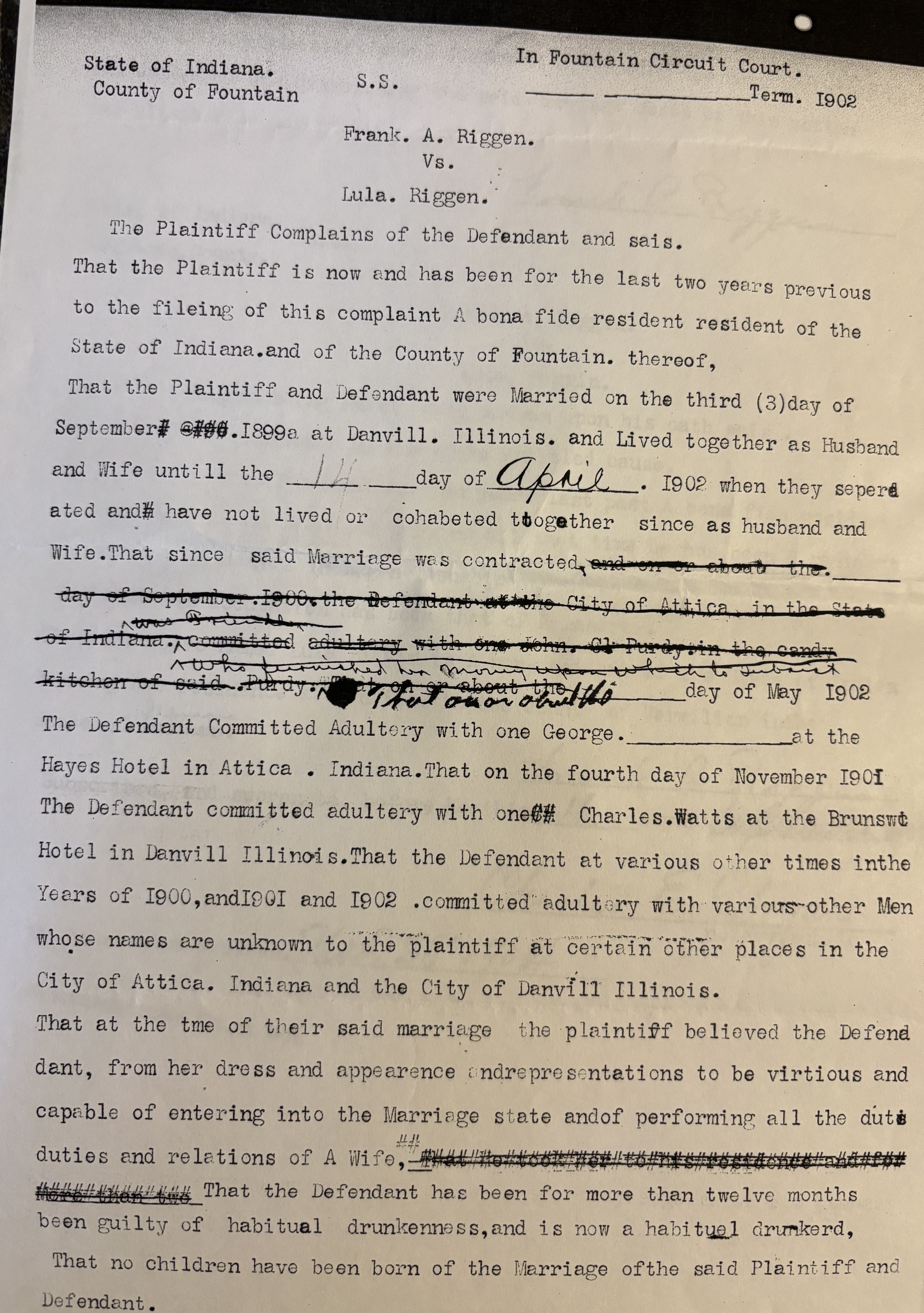
The birth of a daughter, Helen, did not foster a reconciliation between the estranged couple. Instead, on September 16, 1902, Frank sued Lulu for divorce.
Despite his protracted military service, Frank benefited from a military pension and medical (financial) assistance for his various illnesses. He divorced not so much to deny any survivor’s benefits to his estranged wife, but to do likewise to his infant daughter.
To do so, he denied paternity by accusing Lulu of multiple accounts of adultery.
In his complaint, he accused Lulu of adultery nine months prior to the birth of her stillborn sun. Curiously, the incident is crossed out on the document, presumably because the death certificate of the infant clearly states that birth was premature.
Other alleged incidents remained in the complaint, including one dated November 4, 1901.
Maybe these alleged events occurred as documented, but one fact is not included in the complaint: Helen was also born premature.
Many thanks – again – to the Columbus Moving Picture Show – a vintage film festival and memorabilia show held annually over Memorial Day weekend in … Columbus (Ohio).
They very kindly had me as a guest, where I presented my talk on the films of Helen Morgan.
On top of their warm hospitality during the event, they invited me onto their podcast this week.
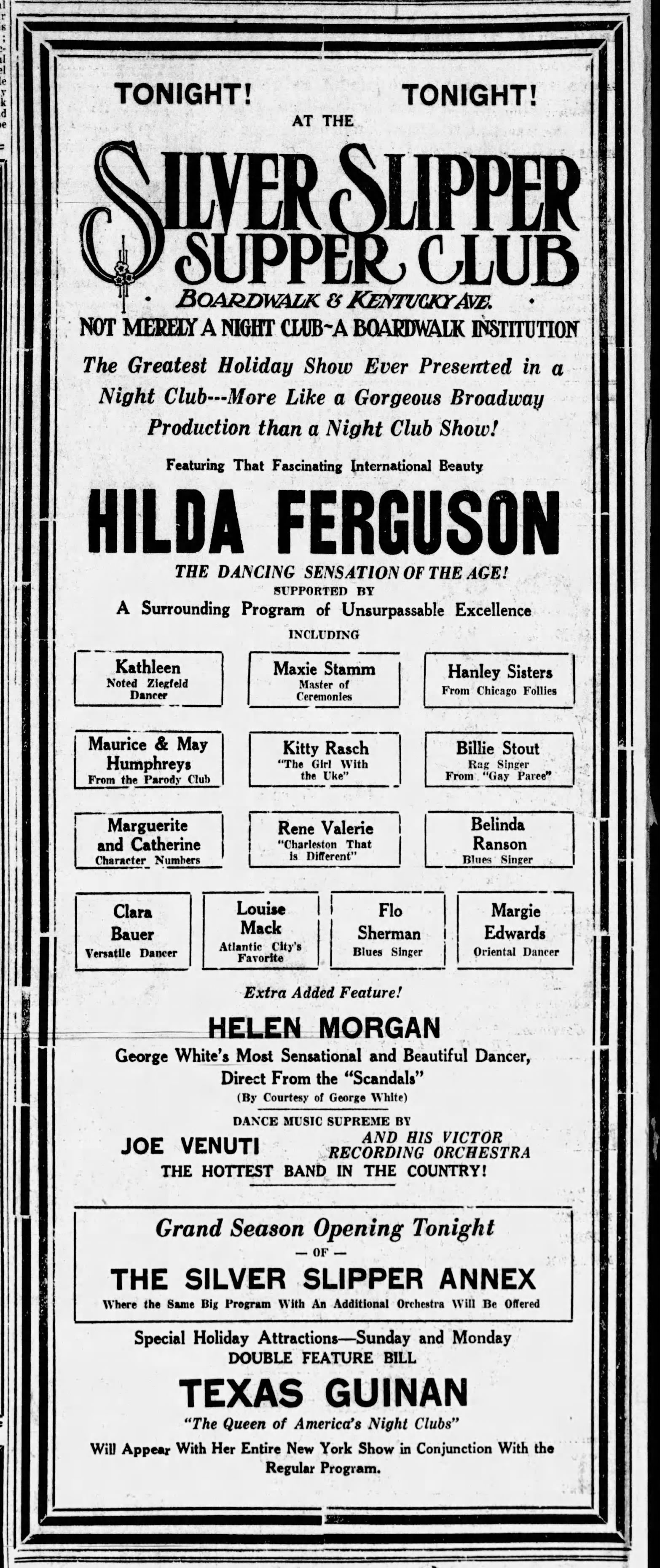
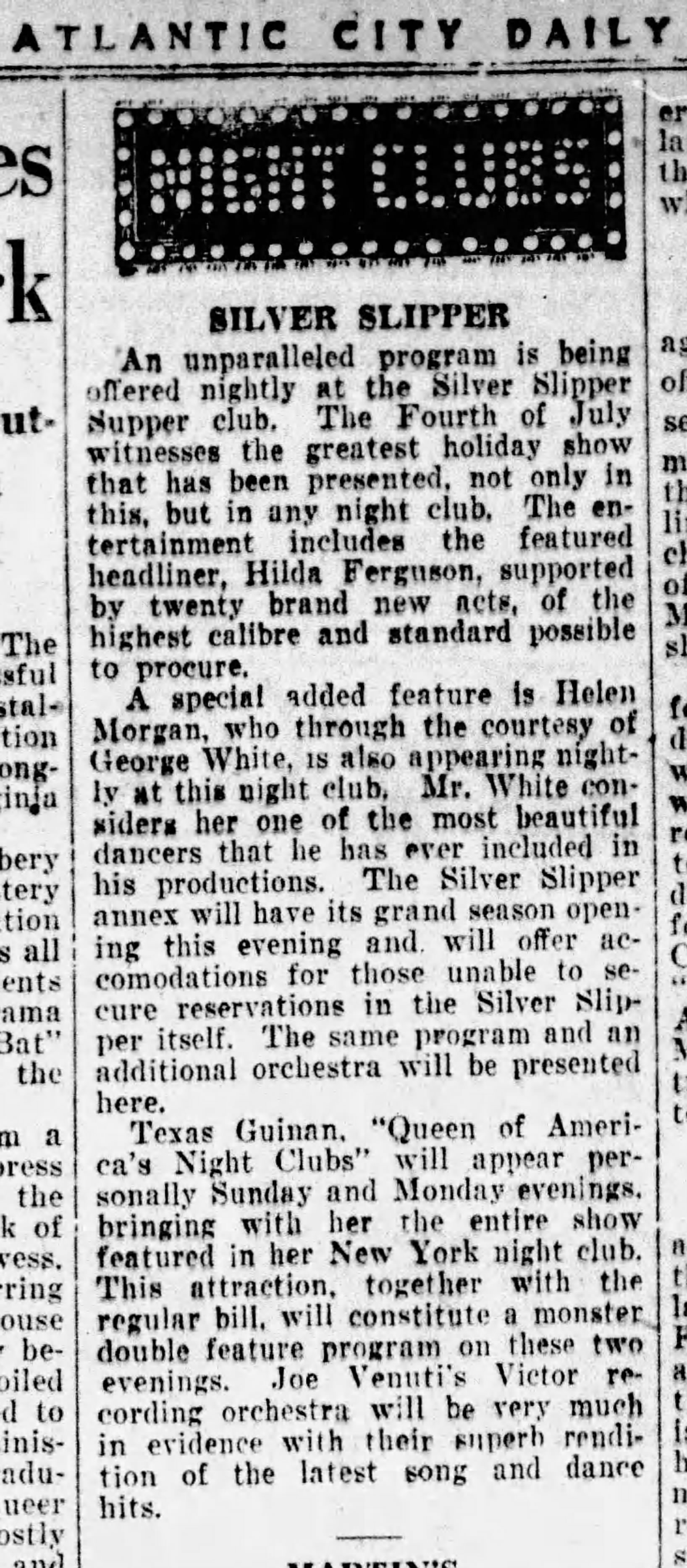
… 1926, Helen Morgan played the Silver Slipper in Atlantic City.
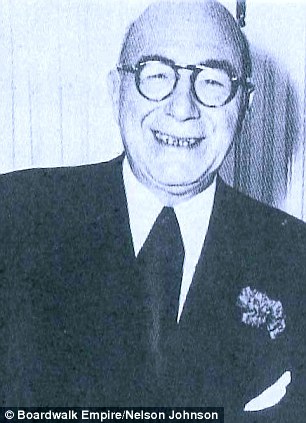
Fans of HBO’s Boardwalk Empire will remember Steve Buscemi’s turn as Nucky Thompson, a character that bore more than a passing resemblance to Enoch Lewis “Nucky” Johnson, the Atlantic County Republic boss and sheriff, who, on the side but never out of view, oversaw bootlegging, prostitution, and gambling in Atlantic City.
Nucky ruled Atlantic City and the Silver Slipper with an iron hand.
Morgan’s tenure proved mercifully brief.
Although she had just come into her own as a cabaret chanteuse at New York’s 54th Street Club, in July 1926, Atlantic City only knew her from her turn in the George White’s Scandals, which held its world premiere the previous summer in the shore town.
And so, Johnson billed her as a dancer. While the content of her act at the Silver Slipper was not noted at length in any review of that week’s show, if safe to assume she did more singing than dancing.
In the end, Morgan’s billing made little difference. The summer of 1926 was one of the wettest on record at the Jersey resort, and business was down across the board. It did not help that Johnson continued to give Hilda Ferguson top billing despite that fact that Morgan had in fact replaced the Ziegfeld dancer as the leading act in the floorshow.
Morgan, at this point, was not a draw in any cabaret outside New York or Chicago, especially under such adverse conditions. Regardless of the size of the house, Helen sang four shows a night, from ten until almost dawn. More demoralizing than the lack of an audience was the request from the management to go out and conspicuously romp on the beach all day after a late night at the club – to drum up business.
Nothing helped, not even the addition of the reigning queen of the nightclubs, Texas Guinan, who brought her entire New York floorshow with her for the Independence Day weekend. That’s right, for two nights, guests were treated to two complete floorshows for the price of one.
And the rain kept the customers away.
Morgan endured this career setback for just one week, when George Raft and his Charleston dancing took over the floorshow.
Helen went immediately into another Broadway review, Americana, although it is unlikely she stepped into the production the following Monday when it debuted out of town, also at the Jersey shore, in Long Branch.
In any event, she was in Americana when it bowed on Broadway on July 26.
More to the point, before Labor Day, she was leading the floorshow at the Playground, the Broadway nightclub run by Texas Guinan’s brother Tommy.
In November, Morgan had her name above the door of her first nightclub.
TCM has cheekily named Mae West its star of the month for May 2025.
In honor of Mae’s days, here is a bit of ephemera:
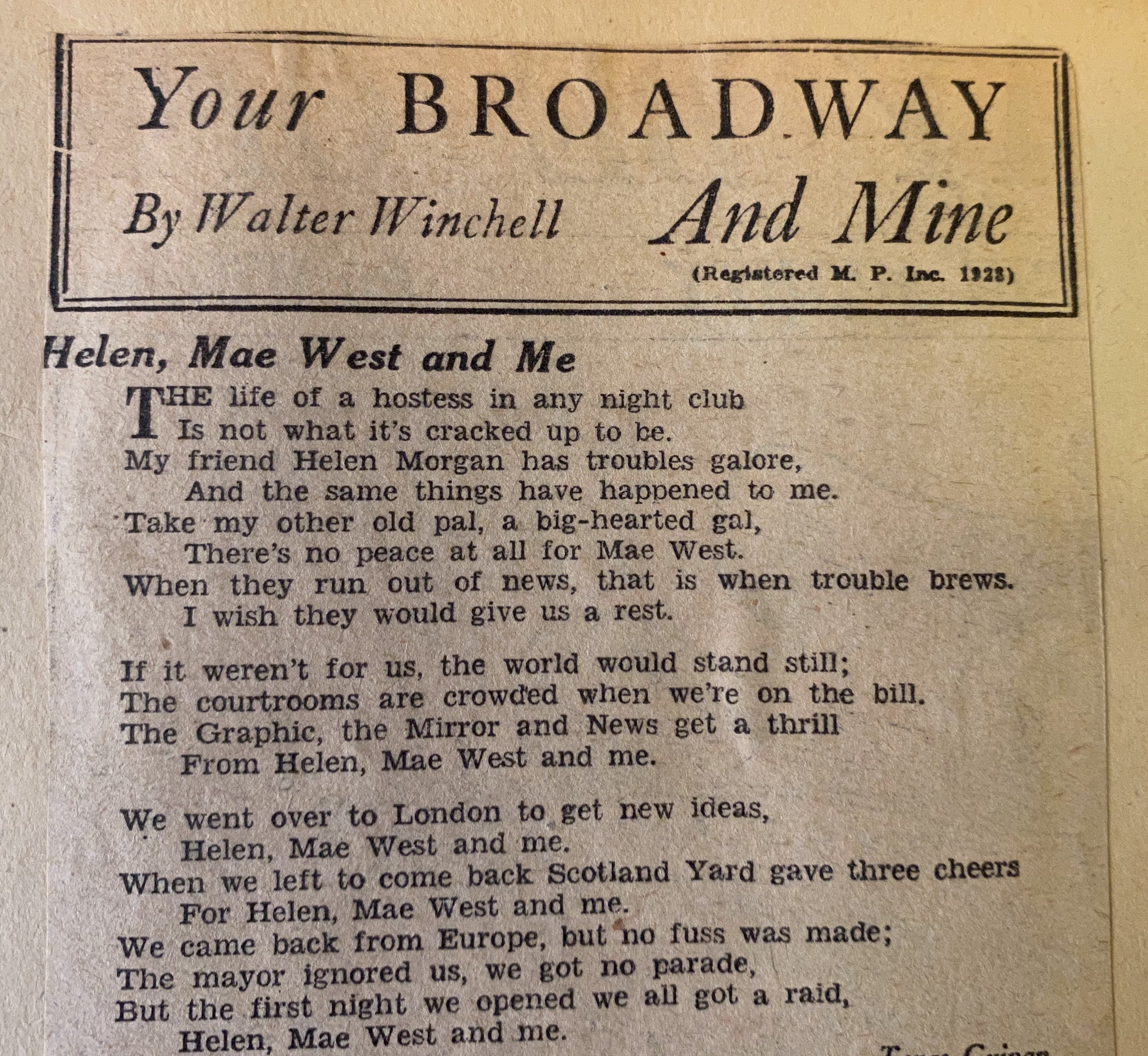
In 1928, Texas Guinan wrote a wryly comic poem about the three raid-prone queens of New York. Morgan and Guinan were among those raided an arrested in the June 1928 prohibition raids. Mae ran into trouble on October 2, 1928, when her latest play, Pleasure Man, was raided and shut down by police following its second performance on Broadway. Mae’s previous scandalous plays, Sex and The Drag were also raided and shut down to protect the morals of New Yorkers. Mae’s depiction of gay men in general, and a drag ball in particular, in The Drag and its reworked iteration, Pleasure Man particularly incensed the morality police.
Some time in the fall of 1928, Walter Winchell gave his daily column in the New York Evening Graphic over to Texas. The Graphic was known for its sensational tabloid content and was often derided as the Pornographic.
… 1934, Helen Morgan recorded her songs for the independent feature Frankie and Johnnie.
The two selections marked the end of her association with Victor Records.
Frankie and Johnnie ran afoul of Joseph Breen and the censors and was not released in its original cut. Victor went ahead and issued Helen’s recordings anyway.
One of Breen’s primary beefs with the film was the old folk song, which he deemed salacious.
Helen’s second song, “Give Me a Heart to Sing To” …
… also vexed the enforcers of the Production Code due to the risqué set on which Helen sang it.
Ben Goetz took control of the project from director Chester Erskine and arranged a meeting with Joe Breen in September 1934, wherein Breen declared, shot by shot and line by line what footage was permitted and not permitted under the Production Code. Helen’s two vocals were excised.
Retakes, to a revised screenplay by Lou Goldberg, commenced in March 1935. To replace “Give Me a Heart to Sing To,” J. Russel Robinson and Bill Livingston provided “It’s You I Adore.”
When editor William P. Thompson discovered enough original 1934 footage to cut around the offending set, “Give Me a Heart to Sing To” was put back into the film, and Helen’s work on “It’s You I Adore” was discarded, although the tune remained in the film’s underscoring.
Morgan never issued a commercial recoding of “It’s You I Adore,” but others, including Morton Downey and Russ Morgan, took the song and ran with it.
Russel and Livingston’s two other songs ended up in the released version of Frankie and Johnnie.
Helen’s replacement for the title tune was “If You Want My Heart (It Belongs to You)” – but her vocal was cut by half before Frankie and Johnnie was eventually released. Freddy Martin recorded the whole thing.
In the film, Helen watches, but does not sing the final Russel and Livingston offering, “Get Rhythm in Your Feet” (And Music in Your Soul). In the film, the song is sung as a spiritual at an African-American wedding.
Commercial covers, especially this one by Benny Goodman, took a more upbeat approach.
Having obtained permission, if not a blessing, from Joe Breen, Frankie and Johnnie hit theatres in May 1936 – days after the release of the Universal film version of Show Boat. Reviews of Frankie and Johnnie were unanimously bad, and while it did decent box office business, the film marked the end of Helen Morgan’s film career.
One final irony: in the two years between Helen’s F&J waxings, many artists, including Bing Crosby, recorded “Give Me a Heart to Sing To,” with the result that when people finally got to see Helen sing it on film, they hummed along – it might as well have been an old folk song … like “Frankie and Johnnie.”
… 1925, one hundred years ago today, Helen Morgan played her final performance as a chorine.
Morgan auditioned – and worked – for Ziegfeld twice before he cast her in Show Boat.
The first time was in 1923. Helen auditioned for that year’s Follies, and Ziegfeld cast her in the chorus … of Sally … set to start its third year as a touring production.
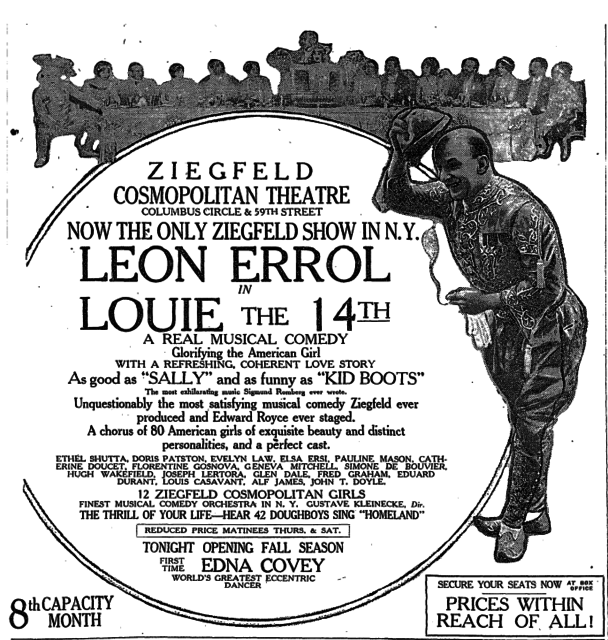
The second time was in late January or early February 1925. Helen auditioned for that year’s Follies, and Flo cast her in the chorus of … Louie the 14th.
Helen was grateful for the work in 1923, but eighteen months later, things were different. By this time, Helen had achieved success as a cabaret soloist in Chicago, and fully intended to make her mark on Broadway as a singer. But, work was work, so she took the job and accompanied Louie on his pre-Broadway tour … while she looked for something better back in Gotham.
Louie the 14th was the star vehicle reward for rubber-legged comic Leon Errol in thanks for leading the company of Sally after Marilyn Miller quit the show – and Ziegfeld – cold. Louie told of American soldiers who stayed in France after WWI. Errol is invited to a ritzy dinner party as an “extra man” to even the table and avoid an unlucky total of thirteen guests. Hilarity ensues.
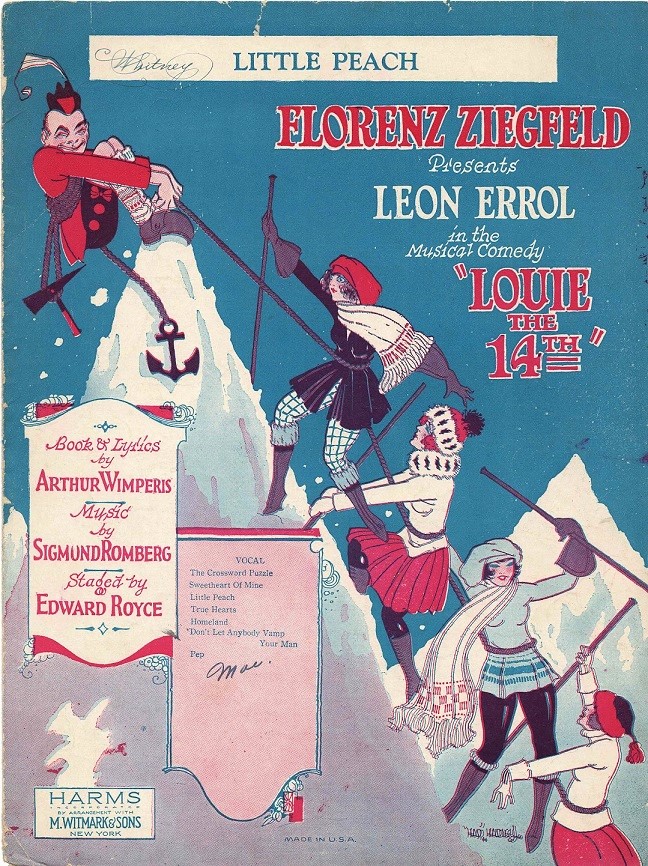
Sigmund Romberg, just 90 days after the opening of The Student Prince, supplied the music to Arthur Wimperis’ book and lyrics.
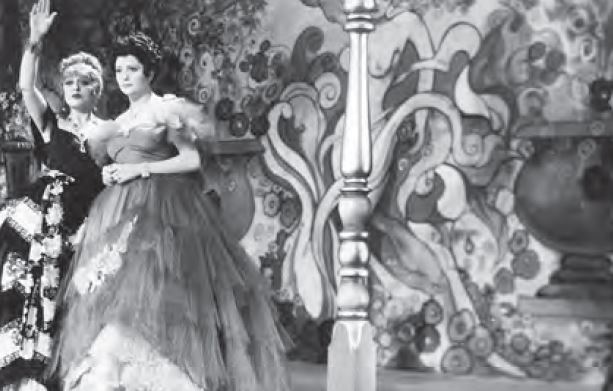
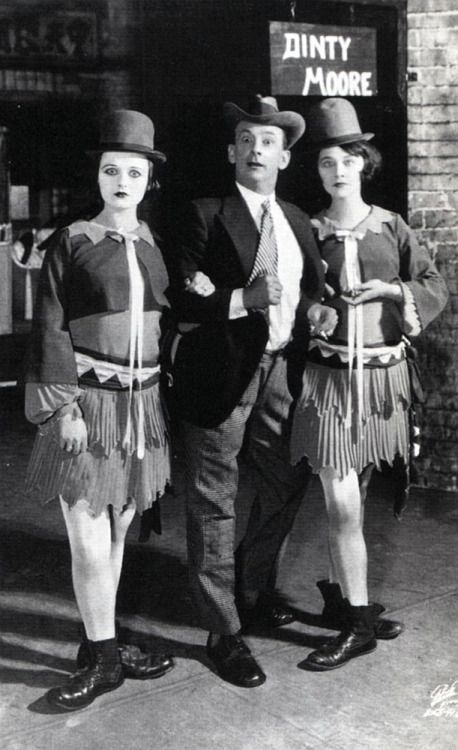
Joining Helen in the chorus were Louise Brooks and Peggy Fears. All were at the start of their careers and all were just about have their break-out success.
And all the ladies participated in the show’s big number, “Little Peach.”
The soldiers also had a stirring anthem, “Homeland.”
Louie the 13th premiered at Ford’s theatre in Baltimore on February 17, 1925. The following week, it played the National in Washington D.C., where Helen played her final performance on February 28, by her own choice: she had found work, as a soloist, in a new York cabaret.
Louie premiered in New York on March 3 at the Cosmopolitan Theatre (Ziegfeld’s Follies continued to have pride of place at the New Amsterdam). The production enjoyed a respectable nine-month run, but that was half of the tally for Romberg’s The Student Prince. The Cosmopolitan’s address – 59th and Columbus Circle – more than fifteen blocks away from Times Square – likely dampened business.
… 1928, Helen Morgan recorded her Show Boat songs.
The event was historic for multiple reasons.
Her waxings proved to be, essentially, the only commercial recordings by any member of the original Broadway cast.
The day’s session marked Helen’s initial work for Victor Records and her first recordings made in America (the previous summer, she waxed twelve sides for the London version of the Brunswick label.)
Morgan would record exclusively for Victor for the next six years. Frustratingly, she was an infrequent guest to the Victor studio and a year would pass before she again appeared before their microphone. During this era, Victor was more interested in dance bands than vocalists: they only hired Morgan to sing songs they knew would sell … and sell they did.
First up was “Can’t Help Lovin’ Dat Man.” Helen begins this cut with her brief solo from “Mis’ry’s Comin’ Aroun’,” despite the fact that the latter number was cut prior to the Broadway premiere. She repeated the verse as an introduction to her 1932 recording for Brunswick.
Note her billing. The label “comedienne” hardly applies to the flip-side, her initial go at “Bill.”
I wrote that, essentially, these are the only commercial recordings made by the original Broadway cast of Show Boat. A few caveats are in order.
Jules Bledsoe, who originated the role of Joe in 1927, eventually recorded “Ol’ Man River” in 1930 … in London. Paul Robeson, for whom the role was written, was unable to participate in the 1927 Broadway production, but did play the role in London (1928) and appeared in the first Broadway revival (1932) and the Universal film adaptation (1936.) He recorded “Ol’ Man River” multiple times over the years.
In the stage play, Helen Morgan, as Julie, sang “Can’t Help Lovin’ Dat Man” as a solo, before being joined by Queenie, Joe, Magnolia and chorus. Tess Gardella, who originated the role of Queenie – in blackface as her stage persona Aunt Jemina – also recorded “Can’t Help Lovin’ Dat Man” – also on February 14, 1928 – for Columbia.
Neither her vocal nor the bluesy arrangement have much to do with how the song was originally presented on stage, but at the forty-two second mark, she sings Queenie’s brief solo verse that starts the quartet reprise of the song. As such, twenty-five seconds of this recording constitutes an original cast recording.
Howard Marsh, the original Ravenal, made a few recordings for Columbia in the early 1920s. Curiously, most of his output were Irish folk tunes, not souvenirs from his Broadway appearances at the time.
A decade would pass before he recorded again, and so, his most most impressive stage work, in Blossom Time, The Student Prince, and, most importantly, Show Boat, went unrecorded.
Norma Terris, the original Magnolia, never recorded anything, although she appeared in a couple of early film musicals. The team of Eva Puck and Sammy White (Frank and Ellie) never recorded either, although they appeared in a couple of experimental sound films. The team broke up before Universal produced its film adaptation in 1936. White teamed with Queenie Smith and preserved his stage role, including the interpolated song “Goodbye My Lady Love,” for the motion picture camera. Veterans from the 1927 production, Charles Winninger (Cap’n Andy) and Francis X. Mahoney (Rubber Face) also appeared in the 1936 film.
Finally, Bledsoe, Gardella … and Helen … appeared before the cameras in the sound prologue of the 1929 part-talkie film version of Show Boat. As with the paucity of audio recordings, Universal chose to preserve only the vocals assigned to the Black characters.
As of this writing, the film prologue has not been fully stitched back together, but much of it can be seen here.