… 1932, Helen Morgan recorded her Show Boat numbers for the second time. This time on the Brunswick label.
On the surface, Morgan had returned to square one, playing Julie in the first Broadway revival of the seminal musical, a mere three years after the original mounting closed.
But much had changed.
The most lasting change was the death of producer (and Morgan’s father figure) Florenz Ziegfeld Jr. two and a half weeks before she entered the recording studio.
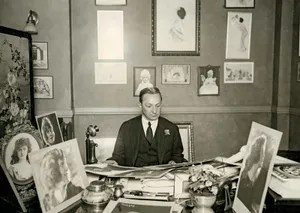
It was a loss from which Helen would never recover, neither emotionally nor professionally, and her grief is all too apparent in the tracks she laid down that day.
Also apparent is the passage of time. As she matured, her voice dropped, which added to the somber tone of the recordings. The change is most apparent during the start of “Can’t Help Lovin’ Dat Man” when she offers (again) a brief quote of the cut “Mis’ry’s Comin’ Aroun'”.
Assisting Morgan is Louis Alter, who added his own rococo piano flourishes when accompanying her. Alter was a songsmith as well as an accompanist, and Morgan remained loyal to him for years. She included many of his songs – notably “What a Life (Trying to Live Without You)” – in her act. Later on, she commercially recorded Alter’s “(I’ve Got) Sand in My Shoes” and “I Was Taken By Storm.”
Here are both sides of her Show Boat disc:
Helen did not record her numbers alone.
Brunswick also brought in Paul Robeson to record his peerless version of “Ol’ Man River” – and then did something extraordinary: the label packaged the four discs they recorded into a single album:
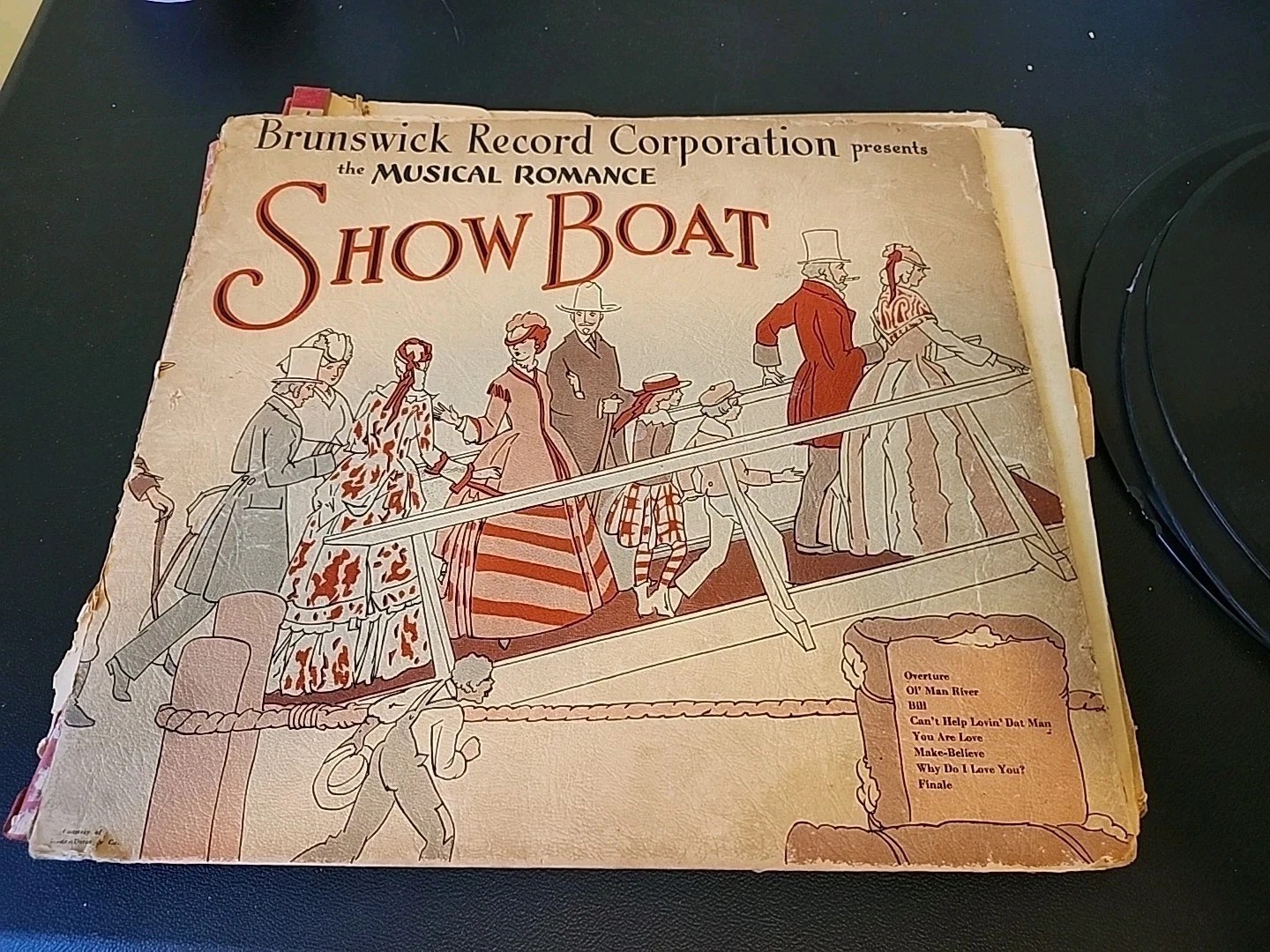
The package marked the first ever Broadway cast album.1
There are some caveats to the above statement that should be mentioned.
Morgan and Robeson were the only members of the 1932 revival cast featured, and they only took three of the eight sides.
Rounding out the “cast” were popular radio and recording artists. Frank Munn and Countess Olga Albani duet on “Why Do I Love You” and James Melton handles “Make Believe” and “You Are Love” as solos.
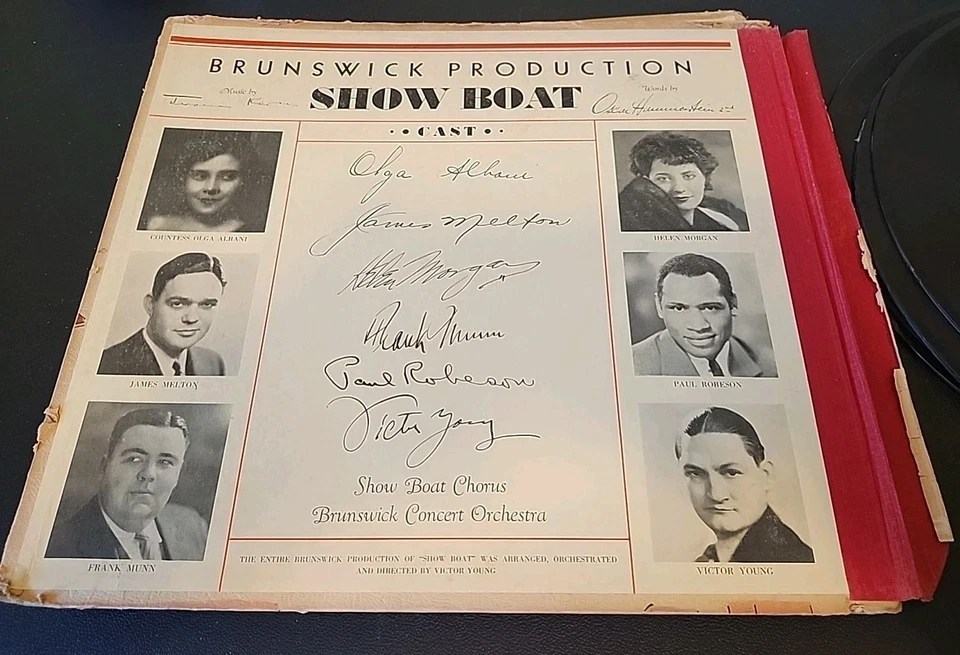
Another caveat is that no one sings to Robert Russell Bennett’s original stage orchestrations. Instead, composer and conductor Victor Young provided his own, bookending the set with an original Overture and Finale culled from melodies from Jerome Kern’s epic score.
James Melton – 2/A – You Are Love” …
… and 2/B – “Make Believe”
Disc #4 – “Why Do I Love You”/Finale
The history of Brunswick is convoluted, so suffice it to say that Columbia gained control of the label and its back catalog in 1939 and phased out the label in 1940.
A year later, Columbia re-released the 1932 album, with new artwork.
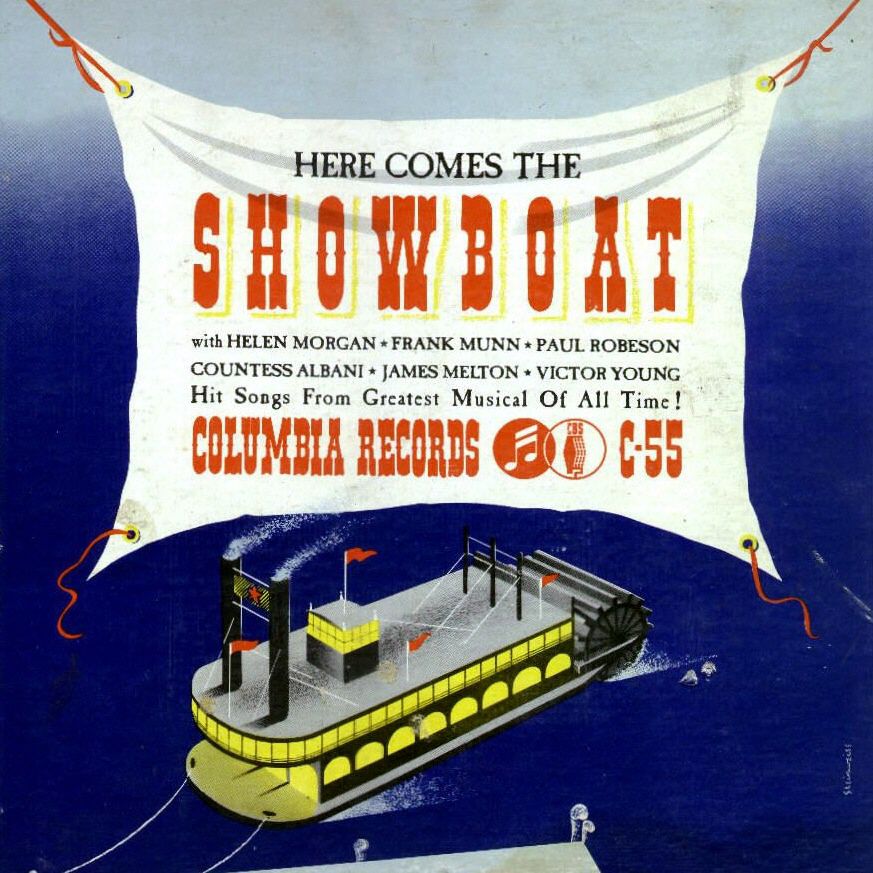
To say that the re-issue was successful would be a understatement. In 1991, the album was inducted into the GRAMMY Hall of Fame. In 2005, the collection was added to the National Registry.
Allowing for various media (78rpm, 33rpm, cassette, compact disc, iTunes, etc.), the album has rarely, if ever, gone out of print during the past 84 years. This happy occurrence proved a great boon to Helen Morgan. When Victor re-released – and re-re-released – Helen’s recordings following her death, their prior contracts did not require the payment of any royalties.
But Columbia’s (if not Brunswick’s) contract did. And while it took ten years of sales to do it, residuals from the Show Boat album paid off the debts Helen left at the time of her death in 1941 and, ultimately, settled her estate.
This site serves as a companion to the book Helen Morgan: The Original Torch Singer and Ziegfeld’s Last Star.
- Six months later, Brunswick recorded a set for Blackbirds of 1928 again with veterans from the 1928 production (Adelaide Hall and Bill Robinson) and those new to the material (Ethel Waters, Mills Brothers, Cab Calloway). Decca took up the gauntlet with two sets for Porgy and Bess (1940 and 1942) and one for This is the Army (1942) – but it was not until Decca waxed Oklahoma! in 1943 that the Broadway cast album became a regular occurrence. ↩︎
 The Helen Morgan Page
Leave a comment