Originally scheduled to open on Hallowe’en, the extensive work decorating the interior of The House of Morgan pushed the premiere back a week. The wait added to the pressure, to the list of almost a thousand denied opening night reservations, and to Helen’s legendary dressing-room hysterics.[i] Part of her anxiety stemmed from a shake-up in the opening night floorshow. The original lineup was to have been: Morgan, mimic Steve Evans, and two bands: the Hernandez Brothers & Lou Bring’s orchestra. A late addition was Frosini, an accordionist – until he suffered a heart attack. To replace his act as well as the dance couple he accompanied, Kannen found Cartier, a less than mesmerizing magician, whose own opening night jitters threatened to sink the production.
Morgan need not have worried: the club and she earned raves. Cartier aside, the rest of the show, including Evans, Beatrice Ide and Jose Limon (dance team), Frances Hunt (singer), columnist-turned emcee S. Jay Kaufman (who also directed) and the dueling orchestras were all top notch.[ii] Helen was back where she belonged. Within days, the club was the most popular nightspot in Manhattan.[iii] As at Chez Helen Morgan, black tie was required to gain entrance to the clubroom although the bar had a less stringent dress code.
After only three weeks, Helen abandoned her House of Morgan to film the 1936 film version of Show Boat. Back east, eight weeks without Morgan placed her House in financial jeopardy. The first post-Morgan line-up consisted of chanteuse June Knight, dancers Escudero and Carmita, and crooner/actor Georges Metaxa. Each act demanded, and was denied, the opulent Morgan dressing room and balcony. Each act sparred over billing; rotating the order in the print ads failed to appease the temperamental players. Each wanted the coveted last spot in the floorshow. Part this problem was temporarily solved when Metaxa was recruited to be the emcee, until a dispute over his flowery excesses in introducing each act prompted him to scream “Double crosser!” and walk out of the second show. Gertrude Niesen and the dance team of Rosita and Fontana completed the remainder of the three-week contract.
In late December, Kannen changed out his personnel, on-stage and off.
Off-stage was Toots Shor, who assisted Kannen in running the room. His greatest accomplishment at the House of Morgan was finding suitable acts to fill in while Helen filmed Show Boat. Drinking one night with the owners of the competing Versailles Club, Toots heard them complain of a lack of original acts in New York. Toots recommended a ventriloquist act. They thought he was mad but gave Shor’s pet act a trial. The ventriloquist went over like gangbusters with the audience, but not the Versailles brass. Toots took the act to Kannen, who booked it into the House of Morgan for the new show, which opened Christmas night, 1935.[iv] The act once again went over big. So big, that Rudy Vallée signed the guy to appear on his radio show and Nelson Rockefeller lured him away to the Rainbow Room.[v] The ventriloquist was Edgar Bergen.[vi]

Sophie Tucker, with a following as loyal as Helen’s, headlined the new bill, which, in addition to Bergen, included Phil Tiltman and Jimmy Lee. She opened to such acclaim she held over for a four week run. Soph also came at $2,500 a week, a grand more than Kannen paid Helen. Out front opening night was Louis B. Mayer, who was so taken by the voluminous entertainer, he hired her. A year later, with pre-Oz Judy Garland, she shot Broadway Melody of 1938 and Thoroughbreds Don’t Cry.
Even with a sold-out New Year’s Eve gala at $30 per couple, the House of Morgan stayed in the red. New Year’s Eve was almost as exciting outside the club as inside. Toots Shor heard a scuffle outside, ran to investigate, and saw the doorman Sam Thorpe take on three men at once. In short order, Thorpe beat each man unconscious. A fourth came up to him and Thorpe knocked him out before Toots could stop him. The last victim was a cop running up to investigate the fracas. Kannen and Toots argued over the incident. The two had words on previous occasions because Kannen would glad-hand his patrons, a responsibility of the club manager. With the dawn of 1936, Toots Shor was gone from the House of Morgan.

Helen returned to the House of Morgan on January 24, 1936. Joining her were Clifford Newdahl, Carl Randall, and Phyliss Cameron. Dissatisfied with the way Kannen was running her club, in early March she left again, picking up club work in Florida. Beginning March 5, Lillian Roth led the floorshow. When Morgan picked up additional work in Chicago, the House of Morgan closed, on March 21, 1936.
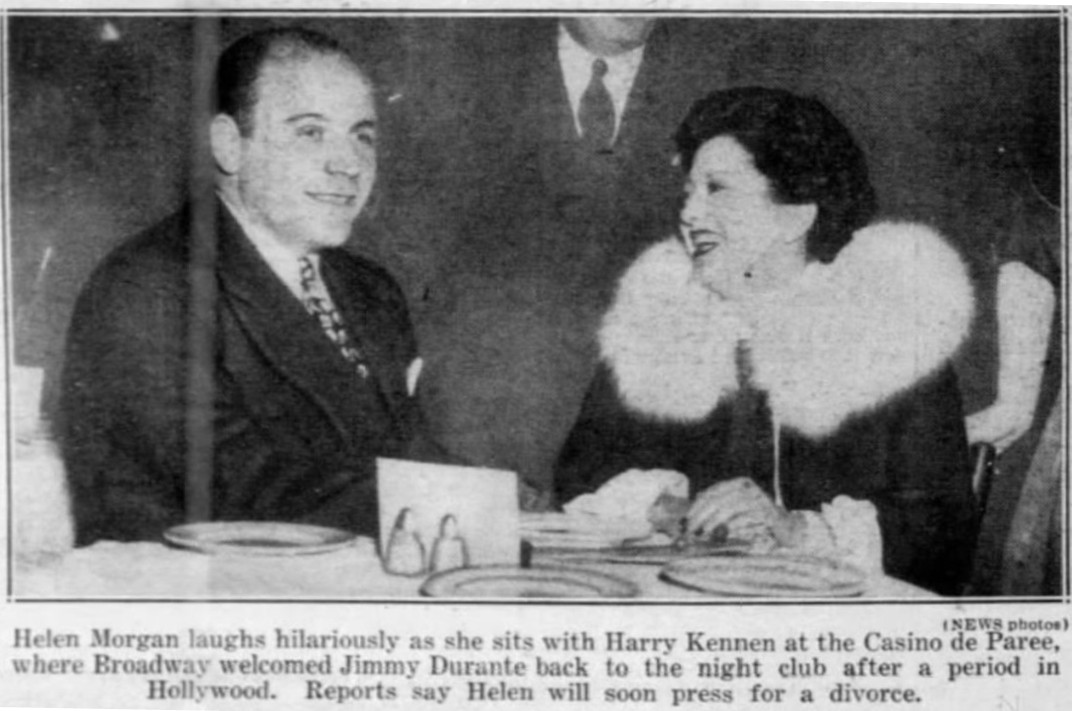
There were certainly problems and a lot of bad timing involved with the House of Morgan. The location itself seemed to be problematic, being just outside the theater district. Further attempts to establish new businesses on the site would also result in failure. First Johnny Borgiani, Nick Prounis and Arnold Rosenfield, owners of the Versailles bought the site off of Kannen, planning to open a club on the site and reverting the Versailles into a straight restaurant. This did not work out. Next, Nick Bates bought the place and re-opened it as the Merry-Go-Round. Dave Appollan, an old vaudeville maestro took the joint off Bates’ hands and opened his club under the handle Club Casanova on October 7, 1938. It was dark again by Armistice Day at a $30,000 loss.
By 1938, if not before, café society in NYC had changed. While successful earlier in the decade, The Stork Club and 21 took over as the premiere niteries. Instead of expensive floor shows, the celebrities who drank and dined in these clubs became the point of interest. Winchell set up his virtual office at the Stork, where he could report on the comings and goings of the café society. Bands would serenade celebrities as they entered the room by striking up a tune s/he had made famous. Even had The House of Morgan survived its season, it could not have survived as the “event” and restricted club it was created to be.[vii]
This site serves as a companion to Helen Morgan: The Original Torch Singer and Ziegfeld’s Last Star, which was published on September 3, 2024.
[i] House of Morgan opening: McIntyre, O. O. “New York Day By Day,” December 18, 1935. Also Richard S. Davis, “Not Exactly a Column”, Milwaukee Journal, January 25, 1936, Daily Variety, October 2, 1935, NYT, October 19, 1935 and Ed Sullivan’s “Broadway,” New York Daily News, November 8, 1935.
[ii] NYT, November 2, 1935 and advertisement, November 7, 1935. Also New York Sun, November 9, 1935 and Abel, Variety, November 27, 1935
[iii] Its popularity even ‘ruined’ the gala openings of the 54th Street Montmartre – Variety, November 13, 1935
[iv] New York Herald Tribune, December 18, 1935.
[v] The Evening Independent, October 8, 1937.
[vi] Considine, Bob. Toots. Meredith Press, New York, 1969, p. 39-41.
[vii] Schenectady Gazette, December 9, 1938.
 The Helen Morgan Page
Leave a comment