Ninety-nine years ago, tonight, Helen Morgan made her Broadway debut in the seventh edition of George White’s Scandals.
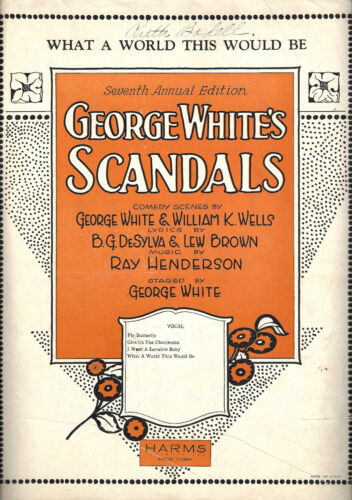
As was often the case in a George White production, there was more drama backstage than on.
On Broadway in the mid-1920s, multiple annual revues played simultaneously. Competition was fierce and original staging ideas increasingly rare. The 1925 Scandals beat Artists and Models to the punch by only three days with identical staging effects: a wisteria arbor, a rose ladder and a fan with changing lights (for Helen Hudson’s first act curtain “Beware of the Girl with a Fan.”) The fan and arbor effects were imported from Paris, the ladder a nod to the old Hippodrome shows. Although scheduled to open at the Winter Garden the Saturday before the Scandals, the Shuberts hastily cut and restaged their show and delayed its opening until the following Wednesday. Ziegfeld also planned to use the Parisian effects for the summer edition of his 1925 Follies on July 6. Following the brouhaha between White and the Shuberts, Flo cancelled his plans and successfully trashed his rivals with the announcement that his revue would contain strictly American ideas.
French designer Max Weldy inadvertently contributed to this Gallic backlash with costumes Erté and he provided to both the Scandals and Artists and Models. Supposedly promised and then denied work, a disgruntled costume shop tipped off the U.S. Customs Office. The Americans alleged that Weldy shipped his French creations into the U.S. in an unfinished state in a ploy to get around paying U.S. customs. White counter-charged that his Scandals clothes came into the country through the proper channels. In fact, White claimed the government owed him a refund since the value Weldy voluntarily placed on the costumes at the time of import was higher than their eventual street value.[i]
White endangered the New York run by offering local ticket brokers only the first sixteen weeks and at a ten percent return. When the Shuberts learned of White’s offer, they withdrew their more equitable twelve week/twenty-five percent deal to handle Artists and Models and resubmitted with White’s cutthroat figures. The brokers balked and refused to handle either attraction. Within a week, the kerfuffle was resolved, at least with the Shuberts, largely in the brokers’ favor.[ii] Some brokers hammered out a compromise with White. Some continued the embargo. In response, critic Sime Silverman began his pan of the Scandals with this catty suggestion: White’s ticketing shenanigans qualified him to work as a ticket seller should his producing talents leave him. Following its tussle with White over this edition, Variety predicted an early tour less than two months into its New York run. Outraged, White forbade his artists from placing advertisements in the show business bible. Variety countered by chiding the petulant producer in print.[iii]
In spite of some negative review, White’s ruthless business moves, and an unusually hot New York summer, the show played to decent houses. Usually grossing about $25,000 a week (capacity was about $33,000), the show owed its healthy run primarily to name recognition and the legacy of the edition that preceded it.
As for Helen Morgan, White hired her with the intention of molding her into a singing comic along the lines of Winnie Lightner. Helen’s work with two songs, “I Want a Lovable Baby” and “What a World This Would Be” were more than satisfactory. Her first attempts at dialogue, in the skits “Drama Mixed with Revue” and “Cheap Guy,” less so. “I wasn’t so good either, because they cut my lines after the first night,”[iv] White may have trimmed her dialogue, but she played both skits throughout the run. The cuts she suffered, actually, were musical: the McCarthy Sisters took over “I Want a Lovable Baby” six weeks into the New York run.
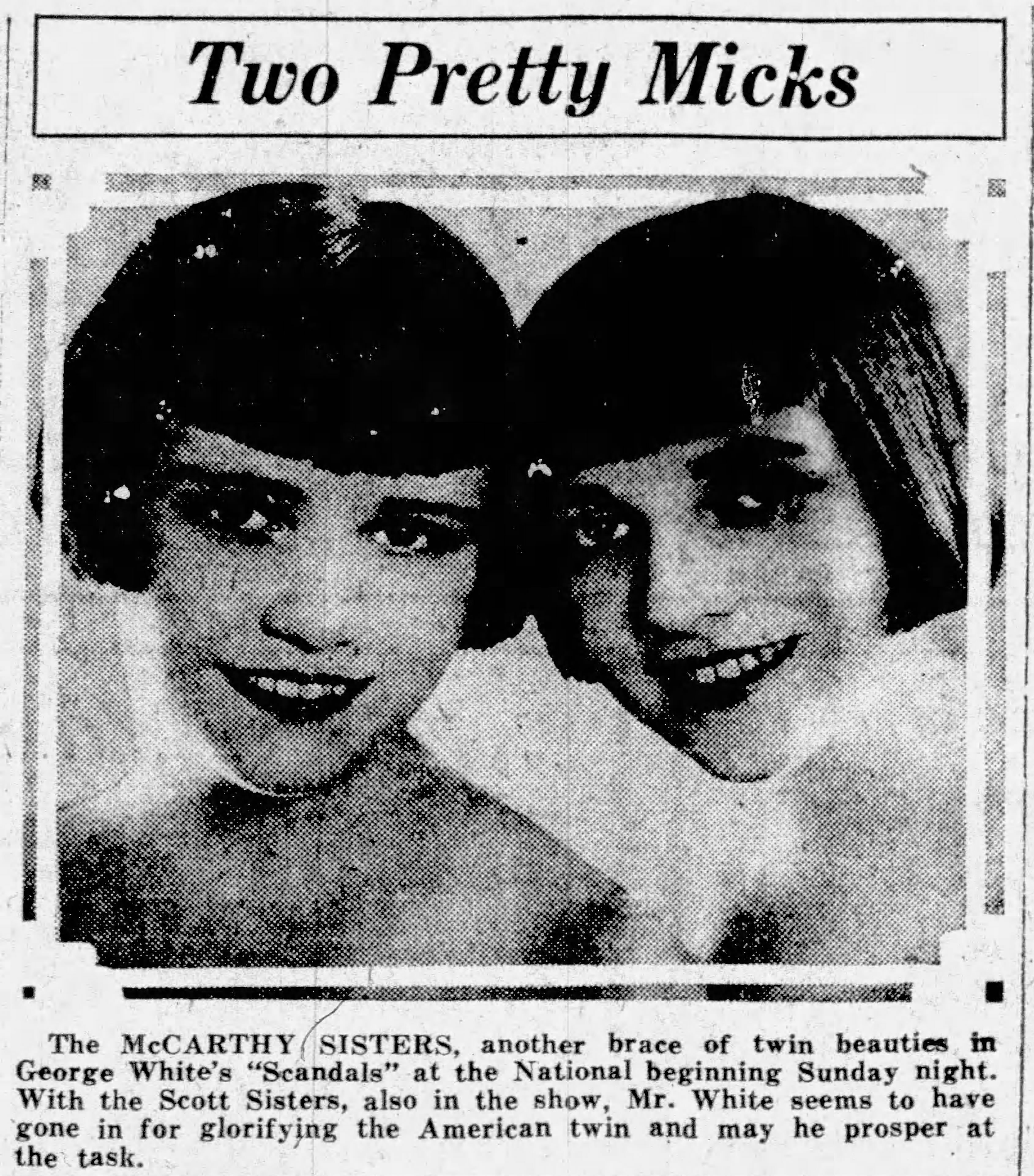
White did not re-assign “Lovable Baby” to punish Morgan. When the New York critics mistakenly credited some of Morgan’s work to the show’s star, Helen Hudson, White hired Morgan to understudy Hudson: if the critics confused the two Helens, the public likely would as well.
Throughout the Broadway run, White changed the running order of the skits and songs, partly to improve pacing, but also to allow Morgan to play both her material and Hudson’s should the latter not go on. The biggest benefit to White’s shuffling: moving Tom Patricola’s Act Two Charleston showstopper to the Act One finale position and repositioning Hudson’s “Beware of the Girl With a Fan” to the eleven o’clock spot in the second act.
Helen Morgan never went on for Hudson in New York, but she did play a great many performances on the post-Broadway tour. She even picked up Hudson’s second act skit, “The Joneses.”
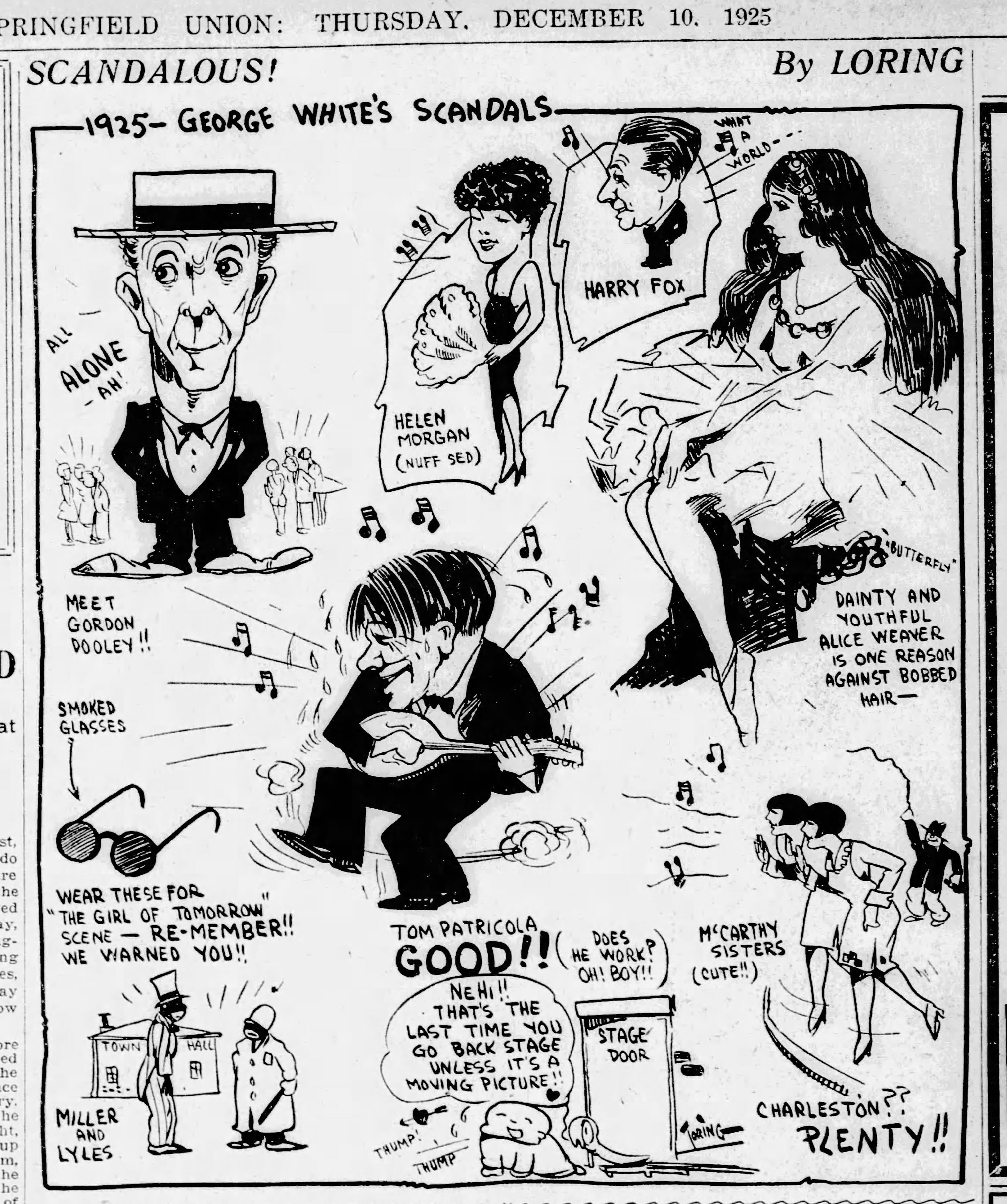
Nuff sed.
This site serves as a companion to Helen Morgan: The Original Torch Singer and Ziegfeld’s Last Star. Ask your local independent bookseller to stock it today!
[i] “American Costume Experts to Appraise Weldy’s Work,” The Billboard, July 4, 1925, 11.
[ii] “Off Buys for new Shows; Garden Over ‘Scandals’,” Variety, June 24, 25.
[iii] Sime Silverman, “Scandals,” Variety, July 1, 1925, 21. Also “Inside Stuff,” Variety,
July 8, 1925, 20, 40.
[iv] “… cut my lines after the first night.” – The New York Graphic, April 19, 1929
 The Helen Morgan Page
Leave a comment